I have sat across the table from enough business owners to know the look. Tired eyes, tight jaw, spreadsheet open on the laptop they have been staring at since 4am. And then they say it.
“We just need more capital. If we had more cash coming in, we would be fine.”
No. No you would not.
I say this with love, hard experience, and a collection of war stories that would make a good Netflix series.
At Purple Turtle Capital, we have acquired companies, taken partial stakes, and rolled up our sleeves inside businesses at every stage. And the number one reason smart people make their situation dramatically worse is this: they treat cash flow problems with a cash infusion.
That is not a solution. That is a faster way to arrive at the same cliff.
Here is what actually happens when you pour money into a broken cash flow machine.
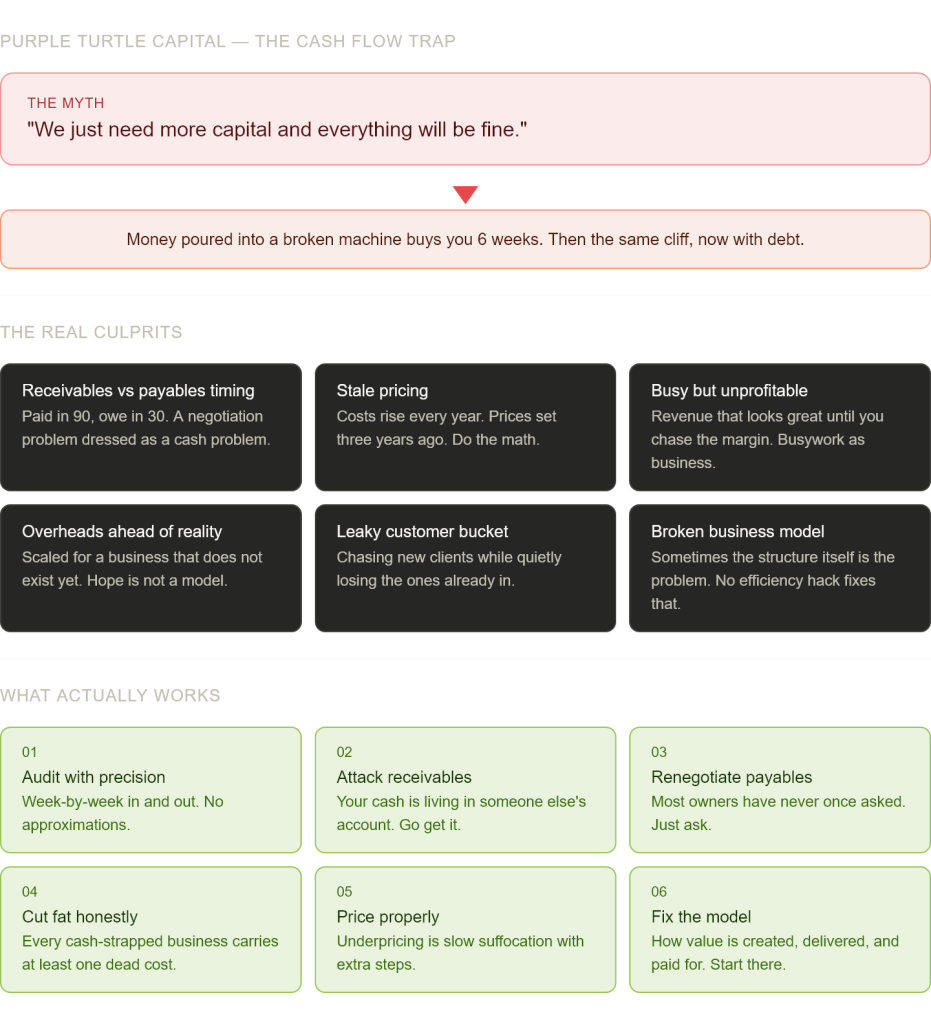
You cover the symptoms. The late supplier payments disappear. Payroll clears. Everyone breathes for about six weeks. Then the exact same problem resurfaces, except now you have debt on top of it, or you have diluted your equity, or both. You have not fixed anything. You have just paid a premium to delay the reckoning.
Cash flow problems are never about cash. They are about behaviour, structure, and timing.
The real culprits nobody wants to talk about:
Customers paying you in 90 days while you pay suppliers in 30. That is not a funding gap, that is a negotiation problem you have been avoiding.
Pricing that was set three years ago and has never moved, while your costs have gone up every single year. That is not a revenue problem, that is a courage problem.
Products or services that are busy but unprofitable. Revenue that looks impressive until you actually follow the margin. Busywork dressed up as business.
Inventory, staff, or overheads scaled for a version of the business that does not exist yet. Hope is not a financial model.
Chasing new customers while the leaky bucket underneath you quietly drains the ones you already have.
So what should you actually do?
First, stop. Genuinely stop and audit where the money goes and when it comes in. Not roughly. Precisely. Week by week. You cannot fix what you refuse to clearly see.
Second, attack the receivables. If customers owe you money and they are sitting on it, that is your cash living in someone else’s account. Chase it, restructure terms, offer early payment incentives, or accept you have the wrong customers.
Third, renegotiate your payables. Most business owners have never once asked a supplier for better terms. Ask. The worst they say is no and you are exactly where you started.
Fourth, cut the fat with honesty. Not the bone. The fat. Every business carrying a cash flow crisis is also carrying at least one cost that made sense once and does not anymore.
Fifth, price properly. Under pricing is not a competitive strategy. It is slow suffocation with extra steps.
Sixth, and this is the one people skip entirely, look at your model. Not your marketing. Your actual business model. How value is created, delivered, and paid for. Sometimes the problem is structural and no amount of efficiency fixes a fundamentally awkward design.
Now, should you ever raise capital or bring in investment? Absolutely yes. We do it regularly.
But capital is an accelerant, not a cure.
You pour it on a working engine to go faster.
You do not pour it into an engine that is on fire and call it a strategy.
If you are considering external investment or a partner to help fix, grow, or scale your operation, the conversation we want to have is about the fundamentals first.
Because the businesses we invest in and acquire are not just ones with potential. They are ones with problems we know how to solve.
And the first problem we solve is usually the story the owner told themselves about why they just needed more money.
If any of this landed uncomfortably close to home, that is probably the conversation worth having.
Purple Turtle Capital. We go in where it matters. Contact us today